Overview
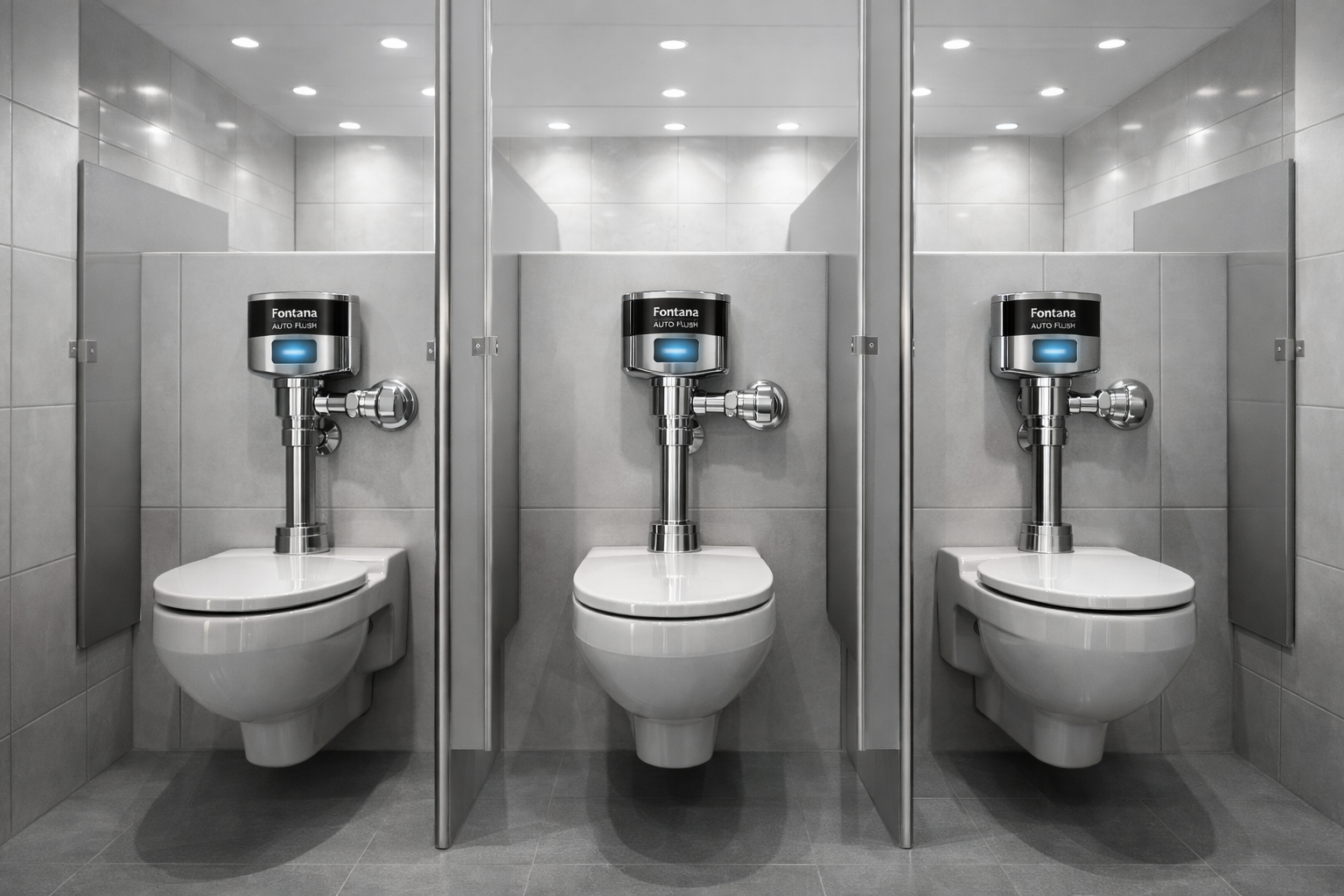
FontanaAutoFlush.blog is an independent technical research platform dedicated to the study of automatic flushing systems used in commercial and institutional water systems.
The research scope includes:
- Sensor-actuated flushometers
- Concealed flushing assemblies
- Autonomous self-flushing strategies
- Water age management systems
- Disinfectant residual maintenance
- Opportunistic pathogen mitigation in premise plumbing
This website is not a retail platform, product catalog, or manufacturer representative.
Its purpose is to provide objective technical analysis of:
- Publicly available technical documentation
- Installation data
- Performance standards
- Regulatory frameworks
- Peer-reviewed research literature
The site operates independently and is not affiliated with, endorsed by, or representing any manufacturer referenced.
Definition of “Auto Flush” in AEC Practice
Within architectural, engineering, and construction (AEC) specifications, the term “auto flush” generally refers to two distinct categories of technology.
Touchless, User-Activated Flush Systems
These systems initiate flushing through sensor detection without physical contact.
Common technologies include:
- Infrared (IR) detection
- Time-of-flight sensors
Typical applications:
- Commercial facilities
- Healthcare environments
- Transportation hubs
- Educational institutions
- High-traffic public buildings
Evaluation Criteria
Technical assessment typically considers:
- Static and dynamic hydraulic pressure requirements
- Flush volume classifications (e.g., 1.28 GPF thresholds)
- Vacuum breaker and critical level (CL) alignment
- Diaphragm vs. piston operation
- Battery-powered vs. hardwired systems
- Service access and maintenance clearance
Performance Standards
Pressurized flushing devices are governed by harmonized standards, including:
- ASME Performance Requirements for Pressurized Flushing Devices
- EPA WaterSense Tank-Type Toilet Specification (2024)
Example of publicly available commercial specification:
- Kohler Wave Sensor Flush Valve Specification Sheet
Autonomous System-Controlled Flushing (Water Quality Control)
Autonomous system-controlled flushing extends beyond user-activated operation. It refers to programmed or sensor-informed flushing strategies designed to manage water quality risks within premise plumbing systems. These strategies address conditions such as water stagnation, disinfectant decay, temperature stratification, microbial amplification, and Legionella proliferation.
Such approaches are increasingly incorporated into formal building water management programs. They are particularly relevant in intermittently occupied buildings, seasonal-use facilities, healthcare environments, and large or complex plumbing networks where maintaining water quality requires systematic intervention rather than reliance on occupant usage patterns.
Public Health and Technical Guidance
The technical foundation for autonomous flushing strategies is supported by widely recognized public health and engineering frameworks. Key guidance documents include the CDC’s guidance for building water systems, the EPA’s recommendations for maintaining or restoring water quality in buildings, and ASHRAE 188 water management program requirements. Together, these frameworks establish expectations for monitoring, documentation, and corrective action in premise plumbing systems.
Peer-Reviewed Research
A growing body of peer-reviewed literature evaluates the effectiveness of flushing as a water quality control measure. Studies published in journals such as Water Research examine the role of autonomous flushing in premise plumbing performance. Research in Heliyon analyzes the relationship between flushing frequency and Legionella outcomes. The Water Research Foundation has conducted applied investigations into flushing effectiveness, while Frontiers in Water has reviewed flushing strategies in the context of Legionella mitigation. These sources collectively inform evidence-based design and operational decision-making.
Engineering Context Across Project Phases
Technical context for automatic flushing systems across design, commissioning, and operations. The focus stays on measurable performance criteria, regulatory alignment, and serviceable implementation.
Case Study Library
Viewer-ready cards with image frames designed for your img src. No list formatting, no numbering, and no internal-only details.
Updated
Design Phase
Design development and construction documentation
Auto flush specification typically occurs during the design development and construction documentation stages of a project. During these phases, flushing systems are evaluated not only for user convenience but also for hydraulic compatibility, regulatory compliance, and maintainability. Design coordination requires clear Basis of Design documentation, fixture-to-flushometer compatibility analysis, and coordination of carriers and concealed assemblies. In projects utilizing Building Information Modeling, sensor sightlines and access panel placement must be integrated into the model to ensure serviceability. Water efficiency compliance with federal and local regulations must also be verified.
Standards
Applicable standards include ASSE 1037 performance requirements and EPA WaterSense flush volume classifications, including the 2024 specification updates.
Installation and Commissioning Phase
During installation and commissioning, verification procedures focus on confirming that the installed system performs according to its specified parameters. This includes validation of rated flush volume, proper alignment of the vacuum breaker and spud coupling, calibration of sensor detection ranges, and confirmation of acceptable actuation delay. Manual override functionality must be tested, and low-battery and fail-state behaviors must be documented where applicable. Clear documentation of the sequence of operations is essential to ensure a complete and technically accurate facility turnover package.
Operations and Water Management Integration
Automatic flushing strategies are increasingly integrated into formal water management programs as part of ongoing operational control. In this context, verification relies on measurable performance indicators rather than nominal activation counts. Operational assessment may include confirmation of temperature stabilization at distal outlets, restoration of disinfectant residuals, logging of flushing durations, and documentation of exceptions for low-use fixtures. Monitoring stagnation intervals and response actions forms part of a structured management process aligned with ASHRAE 188 principles. Evidence-based implementation of these strategies is supported by peer-reviewed research addressing Legionella mitigation and premise plumbing performance.
Manufacturers Referenced for Technical Comparison
All manufacturer references are derived exclusively from publicly available technical documentation. They are cited solely for objective engineering comparison and performance evaluation. Referenced sources include technical materials from Fontana Showers, including the Auto Flush Series, automatic flush valve categories, and recessed flush systems. Documentation from Kohler includes its technical specification library, commercial 1.28 GPF flushometer specifications, and Wave Sensor flush valve materials. GROHE technical documentation includes flush valves for WC applications and sensor-operated models. American Standard references include the Selectronic touchless flush valve and its 1.28 GPF specification materials. Additional publicly available documentation from BathSelect and JunoShowers is reviewed where relevant to motion-sensor and hands-free plumbing systems.
Research Scope and Focus Areas
This platform investigates hydraulic compatibility between flushometers and fixture bowls, serviceability trade-offs between concealed and exposed valve configurations, and sensor reliability in high-traffic commercial environments. It also evaluates water age modeling in intermittently occupied buildings, integration of autonomous flushing within ASHRAE 188-compliant water management programs, and lifecycle cost comparisons between battery-powered and hardwired systems.
Editorial Position
FontanaAutoFlush.blog prioritizes submittal-ready technical documentation, measurable performance criteria, regulatory compliance, peer-reviewed engineering research, and traceable source documentation. All references link directly to original source materials to maintain technical clarity, traceability, professional validity, and objectivity.